Equivalent on Paper, Risky in Practice: A Purchasing Manager's Guide to Vetting Substitute Devices
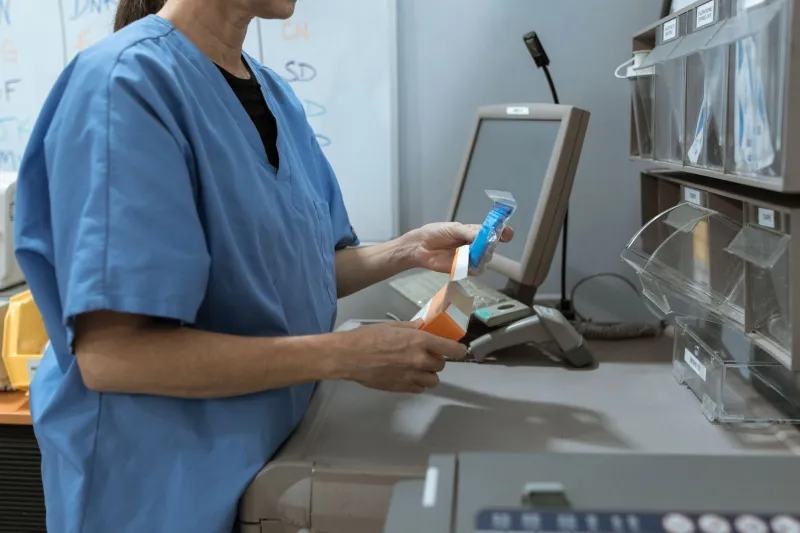
The call usually comes at the worst possible moment. Your order for a staple device — a suture line, a lancing system, an electrode series — is on backorder for six weeks, and your account representative has an alternative in stock. It's FDA-cleared, it's cheaper, and it's 'functionally equivalent.' All you have to do is sign off.
That phrase deserves scrutiny. FDA clearance confirms a device is safe and effective for its intended use against its predicate. It does not confirm that the device is interchangeable with the one your clinicians trained on, your documentation templates reference, or your patients expect. The gap between 'cleared' and 'interchangeable' is where substitution decisions go wrong.
Start With the Predicate, Not the Spec Sheet
Every 510(k)-cleared device was cleared against a predicate — a previously marketed device that serves as its benchmark. Ask the distributor for the clearance number (the K-number) and look up the predicate the manufacturer cited. If the predicate differs substantially from your current branded item, the 'equivalence' claim rests on a comparison you haven't actually reviewed.
Two devices cleared through different predicates may share a product category yet diverge in material composition, mechanism, or performance tolerances. Ten minutes on the FDA's 510(k) database can surface that divergence before it surfaces in a patient complaint.
Interrogate the Material Differences
Biocompatibility is the most common blind spot. A polymer that performs identically in a brochure may differ in latex content, adhesive formulation, lubricious coating, or sterilization method — ethylene oxide versus gamma irradiation, for example, can alter material properties and residual levels.
For skin-contact devices, request the manufacturer's biocompatibility testing summary. For anything implantable or mucosal-contacting, the bar rises further. If your patient population includes documented sensitivities — latex allergies, adhesive reactions — the substitution decision is no longer purely operational.
Price the Retraining Honestly
Clinicians develop muscle memory. A staple with a different firing mechanism, a catheter with a different insertion feel, a wound dressing with a different removal technique — each represents a workflow disruption that carries real cost.
Estimate it: number of staff who touch the device, minutes of in-service training per person, and the productivity loss of a learning curve on the first handful of uses. For high-volume items, retraining can erase the per-unit savings entirely. For low-touch items, the calculus may favor substitution comfortably. Either way, the decision should be made with the numbers, not around them.
Check the Documentation Chain
Substitution touches your records more than most practices anticipate. Ask three questions:
- Does your EHR's order-set or charge-master reference the branded item by name, and does a substitution create a documentation mismatch?
- Will the distributor provide a certificate of conformance and full traceability data for the alternative?
- Does your malpractice carrier or compliance officer require documented rationale for formulary changes?
A substitution made without a paper trail is difficult to defend after an adverse event, even when the device itself performed flawlessly. Treat the change like a formulary decision: documented rationale, dated, signed by the responsible clinician or manager.
A Practical Vetting Checklist
Before approving any 'just as good' substitution, confirm:
- Regulatory basis — K-number obtained, predicate identified, intended use matches your application.
- Material review — biocompatibility summary received; no known patient-sensitivity conflicts.
- Clinical workflow — affected staff identified; training time and learning-curve risk estimated.
- Documentation — EHR references, charge codes, and traceability records aligned.
- Exit terms — trial quantity negotiated; the substitution can be reversed without penalty if performance disappoints.
That last point matters more than it appears. The strongest negotiating position is a limited pilot: order a four-week quantity, gather clinician feedback, and reserve the right to return to the branded item when supply recovers.
When to Say Yes — and When to Walk Away
Substitution is often the right call. When the alternative clears every checkpoint, the savings are genuine and the clinical team endorses the change, you may have found a permanent secondary source — a supply chain resilience win in its own right.
Walk away when the distributor cannot produce the K-number, when material differences touch a known patient-sensitivity issue, or when retraining costs exceed the savings horizon. A backorder is an inconvenience. An unvetted substitution that fails at the bedside is something worse. The difference is decided at the desk, weeks before anything touches a patient.